
Where Did All the Votes Go?
An Analysis of the 42nd Legislative District and Whatcom County Election Turnout.
Would the results have changed for a candidate or an area of the country if the race was not Nationalized ? Read this analysis.
The local 42nd Legislative District race featured good Republican candidates, considerable volunteer effort, and significant campaign spending. Yet, despite these efforts, Republicans fell short. The results appear to reflect a broader national political trend that was difficult for local campaigns to overcome. This trend was evident in all 435 Congressional Races.
The National Political Climate Was a Factor
Across the country, Republicans faced the challenge of campaigning in an election where President Donald Trump’s policies, promises, and continued public presence became a defining issue.
———————————
Foreign policy: Promises to avoid international entanglements were contrasted with at least 3 Carriers groups in the Persian Gulf as of this writing.
Fuel prices: Gasoline and diesel prices became an affordability concern, particularly as voters had been promised lower energy costs through a more aggressive drill baby drill policy.
Ukraine: The promise to end the war in Ukraine remained an issue as the conflict continued.
Relations with China and Russia: The administration’s dealings with Xi and Putin raised concerns and debate among voters.
Tariffs and Canada: Here in Whatcom County, the relationship with Canada and the impact of tariffs have been particularly consequential. Cross-border traffic has reportedly declined considerably, and local businesses dependent on Canadian customers are feeling the pinch.
For many voters, these issues were not necessarily about the individual Republican candidates running in the 42nd or any other district. Instead, the election may have become a referendum on the national Republican message and the President himself.
==============================================
The George H.W. Bush Comparison
There is a historical parallel worth considering.
In 1988, George H.W. Bush famously promised, “Read my lips: no new taxes.” After raising taxes during his administration, the broken promise became a significant political liability in 1992.
The comparison is not exact, but the political lesson is familiar: voters may remember campaign promises long after the campaign itself is over. Even when some promises are kept (closed border), the consequences can extend beyond the candidate responsible and affect other candidates even if the President is not on the ballot; but tells us to imagine he is.
In 2026, Republican candidates in the 42nd may have faced a similar political headwind—one they could not control through local campaign efforts alone.
====================================
What Happened to Voter Turnout in the 42nd?
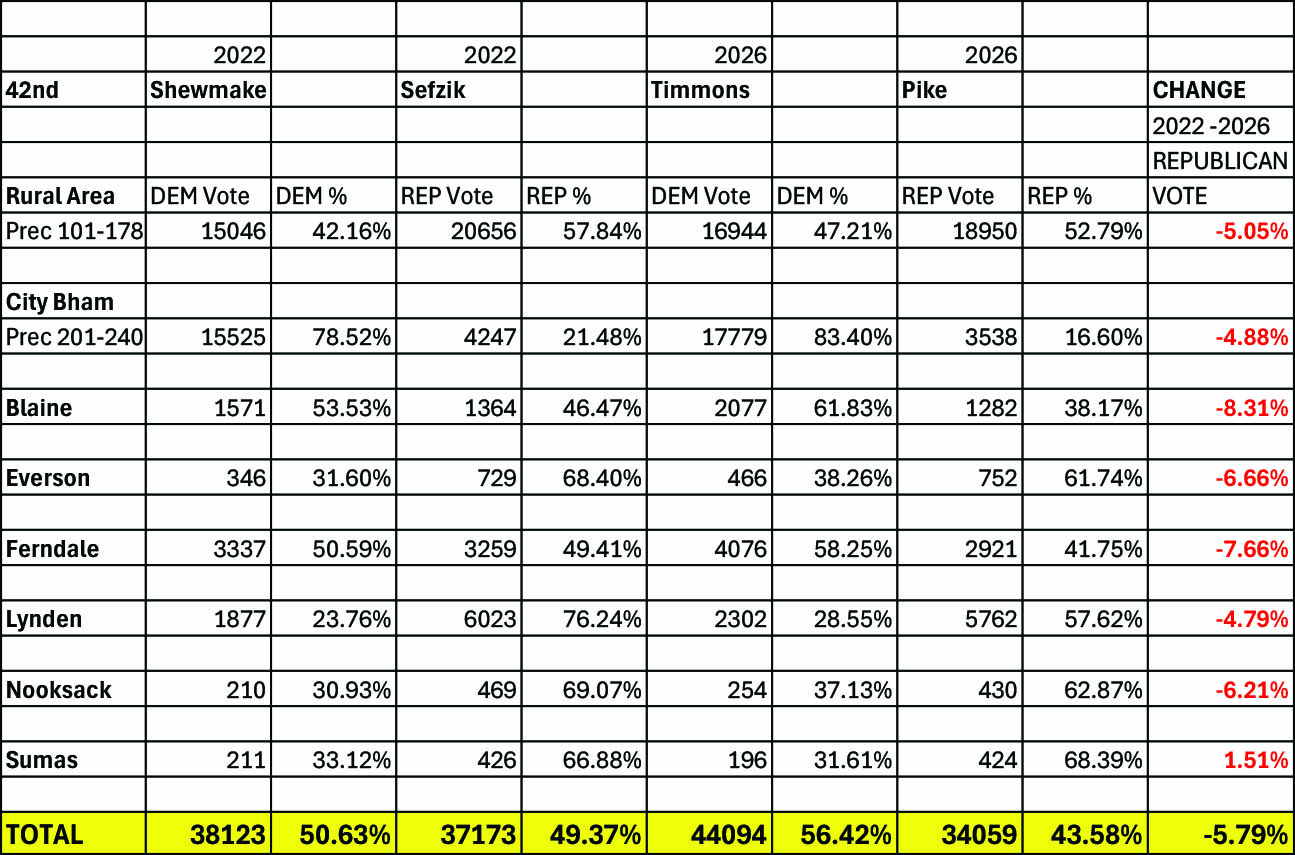
We compared the 2026 results with the 2022 election to examine turnout and voting patterns.
2022 was selected as a comparison year because it provides a useful reference for a midterm election cycle and allows comparisons of turnout and competitive races.
Generally, Whatcom County experiences turnout in the high 80s to low 90s during Presidential election years. In non-presidential even-year elections, turnout typically drops substantially, often by approximately 20 percentage points from presidential-year levels.
For this analysis, we also compared the closest races in 2022 with the closest races in 2026.
42nd District turnout — 2022
69.60%
42nd District turnout — 2026
67.20%
The district’s turnout rate declined by 2.4 percentage points between the two comparison elections.
That decline may sound modest, but when applied to the number of eligible voters in the district, it is an indication of all voters intent to vote.
================================
Approximately 8,770 Voters Did Not Return Ballots
Estimated voters who voted in 2022 but did not vote in 2026 in the 42nd District.
Approximately 8,770 voters who participated in the 2022 election did not participate in the 2026 election, according to the data used in this analysis.
That number raises a critical question for Republicans:
What would the outcome have been if those voters had returned to the ballot box?
The difference between winning and losing in a legislative race can be relatively small. When thousands of voters who previously participated stay home, the impact can be enormous.
The challenge is not simply persuading voters who disagree with a candidate. It is also bringing back voters who may have become discouraged, dissatisfied, disengaged, or unwilling to vote.
==============================================
Was the 42nd District Race Decided Locally—or Nationally?
Republican campaigns in the 42nd worked, spent money, organized, and presented candidates to the voters. However, local campaign efforts may have been overshadowed by national political concerns and in some cases their local impact.
The continued presence of the President’s message in the campaign may have contributed to voter fatigue or dissatisfaction among Republican voters who otherwise would have supported local candidates.
If voters stayed home because of national dissatisfaction, the local candidates may have lost votes without ever having the opportunity to persuade those voters on local issues.
This is a particularly important distinction when analyzing campaign performance. A candidate may run an effective campaign, have strong local support, and still be affected by a national political environment beyond their control. (ai enhanced)

Leave A Comment