
Washington Republicans Must Review Loss and Start Preparing to Win
Opinion | A reader’s perspective on Washington’s midterm election losses
So, what went wrong?
Washington Republicans have plenty of reasons to be frustrated with the results of the midterm elections. Democratic turnout, Redistricting, millions of  dollars spent by public-sector unions and a significant financial advantage all played a role. But if Republicans are serious about winning back seats and eventually changing the direction of Washington State, blaming outside forces cannot become an excuse for failing to do the work.
Republicans at all levels needed to be better prepared, better organized, better funded and better at communicating with voters.
The election should be a wake-up call, not a post-election talking point.
Republicans were behind before the campaign began
Republican leaders acknowledge that the state party needed to raise more money and begin building its get-out-the-vote operation much earlier. That is not a minor oversight. In today’s political environment, voter identification, outreach, volunteer recruitment and turnout operations are built over months, if not years.
Democrats have understood this for a long time. Republicans cannot expect to compete effectively by waiting until election season to build the machinery of a campaign.
The party’s financial disadvantage was significant. According to the Public Disclosure Commission records, the state Democratic Party raised about $2.5 million through the end of October, compared with approximately $1 million for the Republican Party.
When the fundraising totals of the state parties and their House and Senate caucus campaign committees are combined, Democrats raised approximately $10.2 million, compared with $6.6 million for Republicans.
The disparity was also evident at the federal level. Between January 1, 2025, and October 14, 2026, Washington Democrats raised approximately $7.4 million, while Republicans raised approximately $3.1 million, according to the FEC.
Republicans cannot win consistently with a campaign operation that is underfunded, understaffed and assembled at the last minute.
Money does not guarantee victory, but it buys the resources necessary to communicate, organize, identify voters and turn them out. Republicans need to start fundraising now, not when the next election is already underway.
The party needs to get its own house in order
There also appears to be a disconnect between the House Republican caucus, the Senate Republican caucus, the state party and local party organizations.
Republicans cannot afford to operate as separate political islands. Campaign resources, voter outreach, messaging and candidate support should be part of a coordinated statewide strategy. When one organization is working in a different direction from another, opportunities are lost and resources are wasted.
A unified Republican organization means the party needs a common strategy, a common set of priorities and an effective way of supporting candidates at every level.
If Republicans expect voters to believe they can govern effectively, they must demonstrate that they can organize effectively.
The message wasn’t connecting
Perhaps the most revealing post-election observation came from Rep. David Stuebe, R-Washougal, one of the House Republicans losing his seat.
“We thought we had the right messaging but it was too complicated for the average person. It was too easy to blame what’s happening nationally,” Stuebe said. From the Washington Standard Jerry Cornfield
Voters do not necessarily care about the political terminology, legislative process or complicated policy arguments that campaigns often rely on. They care about their household budgets, their taxes, public safety, their children’s education, the cost of housing and whether they can afford to remain in Washington.
It is time to stop talking past voters.
Republicans need to explain, in plain English, why state government is costing more, how policies affect families and businesses, and what Republicans intend to do about it. The message needs to be clear, memorable and repeated consistently.
For example: The high price of gasoline: Iran War; is only a symptom that shows how vulnerable our supplies of refined product are in the United States; after years and years of Democratic party policies at National, State and Local levels. These policies have effectively banned the building of new refineries and not really increased production to keep up with demand in about 70 years!! The same Democratic Party policies apply to our supply of crude for about 70 years as well.
And while national politics did influence our elections, Washington Republicans need to make Washington the center of their campaigns. Voters need to know what their local candidates stand for, not simply what Republicans in Washington, D.C., are doing.
Redistricting was a factor, but it cannot be the entire explanation
The revised legislative district boundaries following the court proceedings involving federal judge Robert Lasnik, a President Clinton appointee, also reshaped the political landscape.
The redrawn map in 2024 shifted more than 300,000 people across 13 legislative districts on both sides of the Cascades. The changes moved more Democratic-leaning voters into districts including the 12th, 14th, 17th and 18th, creating more difficult political terrain for Republican candidates.
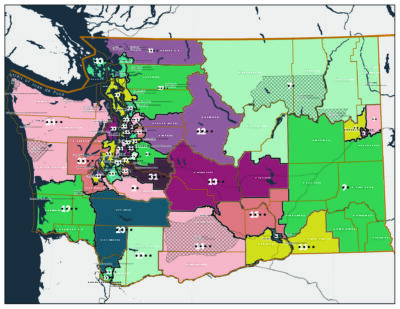 The consequences were felt in races where Republican lawmakers lost seats.
Redistricting matters. Especially done by a Judge for the first time in 50 years in Washington State; in a process that supposedly made the districts friendlier to the election of Hispanics. (A process that was outlawed by the Supreme Court a year later.). Republicans lost 7 seats out of 10 total lost in the districts mentioned above.
But redistricting cannot become a permanent excuse.
The party must adapt to the districts it has, study the voters who now live in them and develop strategies capable of competing. That means understanding voter demographics, identifying persuadable voters and building coalitions beyond the traditional Republican base.
Union spending and the initiative campaigns
The public-sector unions also played a significant role in the election environment.
The Washington Education Association and the Service Employees International Union invested millions of dollars in campaigns urging voters to reject the initiatives. Those campaigns brought financial resources, organized membership and established voter outreach networks to the ballot-measure fights.
From the Republican perspective, the use of substantial union resources to campaign against the initiatives raises questions about the influence of public-sector organizations in Washington’s political process.
Those efforts also helped generate political activity and turnout among voters who opposed the initiatives.
Republicans need to recognize that organized opposition does not simply appear on election day. It is backed by organizations with money, staff, membership lists, communications networks and years of political experience.
If Republicans want to compete, they need to build comparable grassroots infrastructure. They cannot expect to overcome well-organized political opposition with sporadic advertising and a last-minute turnout effort.
Candidate recruitment needs to start now
The next election cycle is already closer than many Republicans realize.
As Rep. Abbarno pointed out, Republicans need to start recruiting good candidates for the next two and four years. That process cannot wait until the filing deadline approaches.
The party needs candidates who understand their communities, can communicate effectively, are willing to work hard and can articulate a compelling vision for Washington. Those candidates need training, fundraising support, campaign resources and encouragement long before they announce their campaigns.
Local party organizations also need to be strengthened. County organizations, precinct volunteers, grassroots activists and community leaders are the foundation of a successful statewide operation.
Republicans need to rebuild that foundation.
No more excuses. Start building.
Washington Republicans have a choice.
- They can spend the next two years explaining why the election was unfair, why Democrats had more money, why union organizations were better funded, why turnout favored Democrats and why redistricting made certain races more difficult.
- Or they can take those lessons, accept the shortcomings that were within their control and begin preparing to win.
- The financial disadvantage was real. The redistricting changes were real. The union spending was real. The National effect was real. Democratic turnout was real.
But so were the missed opportunities to raise money earlier, organize more effectively, coordinate the party’s efforts and communicate a simpler, stronger message.
Winning back Washington will not happen by accident, and it will not happen by simply hoping voters become dissatisfied with Democrats. Republicans must give voters a reason to vote Republican.
That work starts now. Not next summer. Not next fall. Now.
The next election will reward the party that is prepared, organized, funded and ready to communicate.
Washington Republicans have been given a warning. The question is whether they will heed it.
A Reader’s Remarks

Leave A Comment